
Changing a will: reviews and codicils
A read-through of the will you already have, whoever wrote it, and the right way to change it — a codicil for something small, a replacement will for anything substantial.
Last updated
What it costs
- Will Review
- £95
- Codicils
- From £125
Quoted in writing before you commit to anything, and the price includes the signing visit to your home anywhere in Kent and East Sussex — no travel charge, and no extra for an evening or a weekend.
Right for you if: you have a will already, something in your life has changed, and you want to know whether it still does the job.
A will is not a thing you do once. It’s a snapshot of your circumstances on the day you signed it, and circumstances move. The question is never really “is my will valid” — it’s “does my will still do what I’d want it to do today”.
The review
I read the will you already have, whoever drafted it, and tell you honestly where it stands. That means going through:
- Whether it’s still valid at all. Was it executed properly? Has anything happened since that revoked it — a marriage, most commonly?
- Whether the people in it are still the right people. Executors who have died, moved abroad, or fallen out with the family. Guardians named for children who are now thirty. A former spouse still sitting in the document.
- Whether the gifts still work. A specific gift of an asset you no longer own generally fails — the shares you sold, the cottage you moved out of, the account that was closed and reopened elsewhere. The beneficiary gets nothing, and it’s rarely what anyone intended.
- Whether the shape still reflects your life. New children or grandchildren, a second marriage, a business, a beneficiary who has become vulnerable, an estate that has grown enough for inheritance tax to be worth thinking about.
- What it doesn’t cover. Jointly owned property, pensions and death-in-service benefits pass outside the will entirely. A review is usually where people discover that their pension nomination still names somebody they divorced in 2011.
You get a plain answer at the end: it’s fine, it needs a codicil, or it needs replacing. If the answer is that it’s fine, I’ll say so.
Codicils
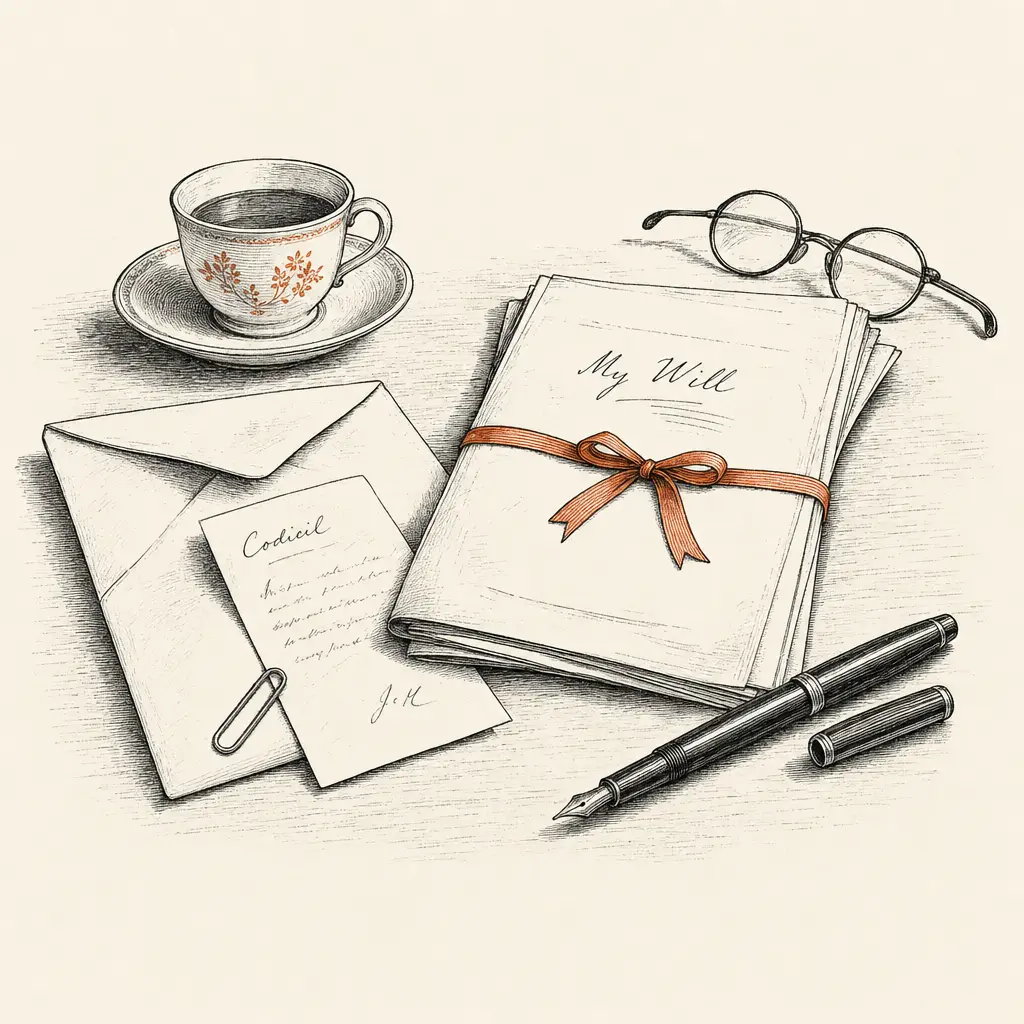
A codicil is a supplement to an existing will — a separate signed, witnessed document that changes part of it and leaves the rest standing. It has to be executed with exactly the same formalities as a will, which is why a codicil written out and signed at home usually isn’t one.
Codicils are the right tool for a genuinely small change:
- Swapping an executor, or adding a substitute.
- Changing or adding a specific legacy.
- Changing a guardianship appointment.
- Correcting a name or an address.
Where a couple with mirror wills want the same change, that’s two corresponding codicils, drafted as a pair for the same reason the wills were.
When a codicil is the wrong answer
Most of the time, once you’re past one or two changes.
Codicils accumulate. Every one of them has to be found, produced and read alongside the original when the estate is administered, and each is another document that can go missing or be executed slightly wrong. A will with three codicils attached is harder to administer, more expensive to prove, and considerably easier to argue about than a clean replacement saying the same thing.
So the rule of thumb I work to: if the change is small, self-contained and the only one, a codicil is cheaper and quicker. If you’re changing the substance of who inherits, or you’re on your second change, a replacement will is clearer and usually costs no more once you count what the executors will spend untangling it.
I’ll tell you which of those you’re in after I’ve read the will. That’s the point of the review.
Common questions
Can I just cross something out and initial it?
No. An alteration made to a will after it has been signed is generally ignored, and the will takes effect as though the original wording were still there — unless the alteration itself was executed with the same formalities as the will, which crossings-out never are. Worse, if the original wording has been obliterated so thoroughly that it can't be read, that gift may fail entirely. If you want to change something, change it properly.
How do I know if my old will is still valid?
Validity and usefulness are different questions, and most old wills fail the second one rather than the first. A will signed correctly in 1998 is very probably still valid. Whether it still appoints people who are alive, names children born since, reflects a house you've moved from twice, or accounts for a marriage or divorce is another matter. A review answers both.
What happens to my old will when I make a new one?
A properly drafted new will revokes all previous wills and codicils expressly, so there's no ambiguity. Once the new one is signed, the old one should be destroyed — not filed "just in case", because a surviving copy is exactly the kind of thing that generates an argument later. I'll tell you what to destroy and when.
I want to leave someone out. Can I?
You can leave your estate to whoever you like — there's no forced heirship in England and Wales. But certain people, including a spouse, a former spouse who hasn't remarried, a child, and someone who was being maintained by you, can bring a claim against the estate for reasonable financial provision. Excluding someone isn't forbidden; it's a decision that needs doing carefully, with a contemporaneous note of your reasons. That is a conversation to have properly, not a line to slip into a codicil.
Not sure whether this is what you need?
That's what the first phone call is for. It's free, there's no obligation, and if something else would serve you better I'll tell you so.