
Will writing in Kent and East Sussex
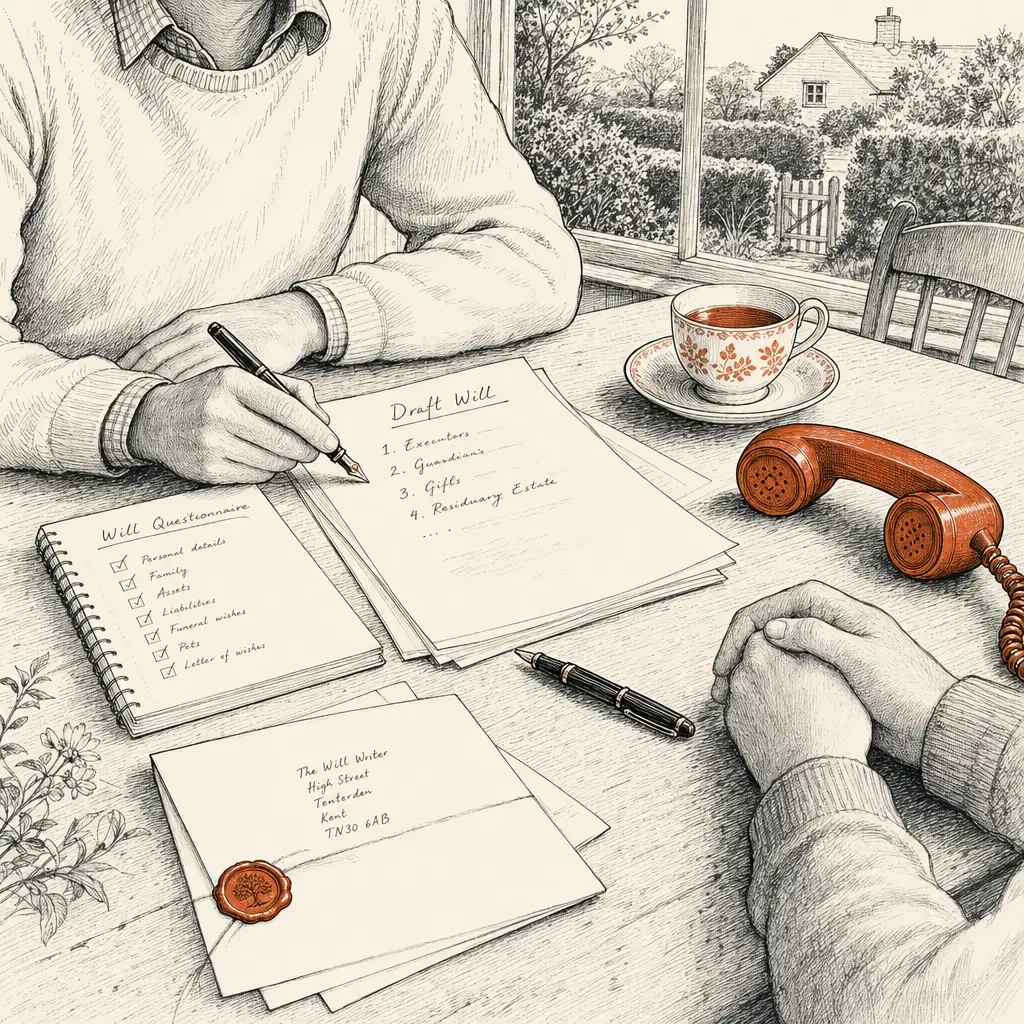
A will drafted from scratch around your circumstances, taken by phone and questionnaire, and signed and witnessed properly at your own kitchen table.
Last updated
What it costs
- Will Writing
- From £225
Quoted in writing before you commit to anything, and the price includes the signing visit to your home anywhere in Kent and East Sussex — no travel charge, and no extra for an evening or a weekend.
Right for you if: you want a will that says what you actually mean, and you would rather not spend a morning in an office to get one.
Most people know they need a will. What stops them isn’t the cost — it’s not knowing where to start, not wanting to spend a morning in an office discussing something this personal, and a vague sense that it will be a long, formal process. It isn’t. For a straightforward estate the whole thing is usually done inside a fortnight, and the only appointment you need to keep is the one where I come to you.
What you actually get
A will drafted from scratch for your circumstances. Not a template with your name dropped into it — I’ve yet to meet two families whose arrangements were the same, and the differences are exactly where template wills come apart.
The document itself does four jobs. It appoints executors, the people who will actually carry out your wishes. It appoints guardians for any children under eighteen, which is the single most important clause in a young family’s will and the one the courts otherwise decide for you. It sets out who gets what — specific gifts first, then everything that’s left. And it deals with the awkward cases nobody wants to think about: what happens if a beneficiary dies before you, if a couple die together, if a gift no longer exists by the time you do.
That last part is where most of the drafting care goes, and it’s invisible until it matters.
How the process runs
A free phone call. No obligation and no charge. You describe your circumstances, I explain the options in plain English, and you get a firm quote before you commit to anything.
A questionnaire. If you’d like to go ahead, I send you a questionnaire covering your family, your estate and your wishes. Fill it in at your own pace — over a week, in one sitting, however suits. We close the gaps by phone and email in as many calls as it takes. Most people expect this part to be a formal appointment. It deliberately isn’t.
Drafting. I prepare the will and send it to you to read properly. Take your time over it. Your job at this stage is to tell me if any factual detail is wrong or if anything doesn’t reflect what you asked for; my job is to change it.
Signing at your home. When you’re happy with the final version I come to you, bring an independent witness, and oversee the signing so the formalities are met. Evenings and weekends included, at no extra charge, anywhere in Kent and East Sussex.
Why the signing visit matters more than it sounds
A will is only valid if it is executed correctly, and the rules are precise. You must sign it, or acknowledge your signature, in the presence of two witnesses who are both present at the same moment. Each of them then signs while you watch. Not later that afternoon. Not one at the kitchen table and one at the front door.
Home-made wills fail on that sequence more often than on anything in the wording, and they fail silently — the document looks completely normal until a probate registry examines it. Bringing a witness with me and watching the signing happen is the least glamorous part of the service and the part that most reliably earns its money.
What a will can’t do
Worth saying plainly, because a lot of people expect otherwise.
- It doesn’t cover jointly owned property held as joint tenants. Your share passes automatically to the other owner, whatever your will says. Changing that is possible, but it takes a separate step — see trust wills.
- It doesn’t usually cover pensions or death-in-service benefits. Those follow a nomination form held by the scheme. If yours still names a former partner, your will won’t fix it. Check them.
- It doesn’t take effect while you’re alive. If you’re worried about what happens if you lose capacity rather than when you die, that’s a lasting power of attorney, and it’s a completely different document.
When a will stops working
A will you signed a decade ago may no longer do what you think. The usual triggers are marriage, divorce, a birth or a death in the family, a house move, or a significant change in what you own.
Two are worth knowing about specifically. Marriage revokes an earlier will, as the law currently stands, unless the will was made in contemplation of that particular marriage — so a couple who marry after years together can find themselves intestate without doing anything at all. Divorce doesn’t revoke a will, but it treats your former spouse as though they had died before you, which can leave gaps where they were named as executor or as the main beneficiary.
If you already have a will and you’re not sure it still holds up, that’s what a will review is for.
Common questions
Is a will I write myself actually invalid?
Not automatically — a home-made will can be perfectly valid. The trouble is that you only find out it wasn't when it's far too late to fix. The formalities are unforgiving: the will has to be signed by you in the presence of two witnesses who are both there at the same time, and who then sign it themselves. Get the witnessing sequence wrong and the whole document fails. Get the wording of a gift wrong and it may fail on its own while the rest stands. Every problem I'm asked to sort out after a death started as a document somebody was confident about.
Can a beneficiary witness my will?
They can, but they shouldn't, and this is one of the most common home-made mistakes I see. If a witness — or that witness's husband, wife or civil partner — is left something in the will, the gift to them fails. The will itself stays valid; the legacy simply disappears. It's a horrible way for somebody to find out they've been disinherited by a signature. When I attend the signing I bring an independent witness precisely so this can't happen.
What should I have ready before we start?
Nothing formal. A rough idea of what you own and roughly what it's worth, who you'd like to benefit, who you'd trust as executor, and — if you have children under eighteen — who you'd want to raise them. You don't need valuations, deeds or account numbers to have the first conversation. The questionnaire I send afterwards walks you through the detail at your own pace, and we fill in the gaps by phone.
Do I need to say where I want to be buried?
You can, but funeral wishes in a will are not binding on anyone, and a will is often not read until after the funeral has happened. That's exactly what a letter of wishes is for — it sits alongside the will, it can be handed to the family straight away, and it can be updated whenever you like without re-signing anything.
Not sure whether this is what you need?
That's what the first phone call is for. It's free, there's no obligation, and if something else would serve you better I'll tell you so.