Trust wills and property protection trusts
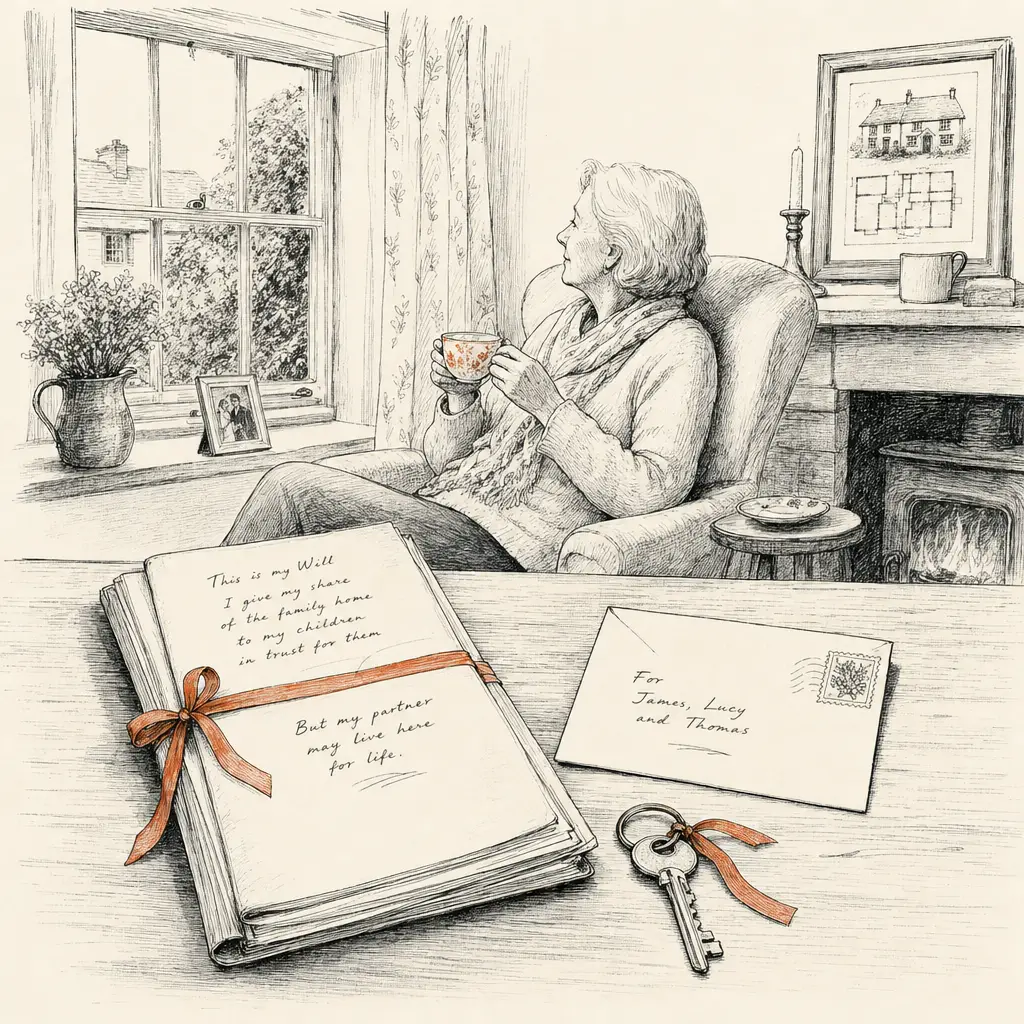
Ringfencing your share of the family home in a trust so your partner can go on living there for the rest of their life, and your own children still inherit your half in the end.
Last updated
What it costs
- Trust Wills
- Price on consultation
Quoted in writing before you commit to anything, and the price includes the signing visit to your home anywhere in Kent and East Sussex — no travel charge, and no extra for an evening or a weekend.
Right for you if: most of your wealth is the house, and you want the survivor looked after without your own children losing their share.
For a great many families in Kent and East Sussex, the house is the estate. Everything else — savings, a pension, the car — is a rounding error next to it. That makes one question unusually important: what actually happens to your half of it?
The problem a trust will solves
Take a couple who each have children from a previous relationship. They make mirror wills: everything to each other, then to all the children between them. It feels fair, and on the day they sign it, it is.
Then one of them dies. The survivor now owns the whole house outright. They are free to make a new will. They may remarry, which — as the law currently stands — revokes their existing will entirely. Years later the house passes to the survivor’s own children, or to a new spouse, and the first partner’s children receive nothing. Nobody acted in bad faith. The wills simply couldn’t promise what everyone assumed they promised.
A property protection trust fixes that. Instead of your half of the house passing outright to your partner, it passes into a trust. Your partner has the right to live there for the rest of their life. When they die, your half goes where you said it should go — to your children — because it was never theirs to redirect.
How it works in practice
Severing the joint tenancy. Nearly every couple owns their home as joint tenants, where the survivor automatically takes the whole property and no will has any say in it. That has to be converted to a tenancy in common, so each of you has a distinct half share that can pass under your own will. This is included in the work, and a trust will without it is worth nothing.
Drafting the trust. Your will leaves your half share to trustees, with your partner given a right to occupy for life. The drafting has to anticipate ordinary life: selling and downsizing, moving into care, who pays for the roof, what happens if the survivor wants to move nearer a daughter in another county. A rigid trust causes as much trouble as no trust at all.
Appointing trustees. Usually the surviving partner plus one or two others — commonly an adult child, so both sides of the family have a hand on it. I’ll talk you through who is suitable and what you’re asking of them.
Where trust wills genuinely earn their keep
- Second marriages and blended families, where you want the survivor secure and your own children protected. This is the classic case and the majority of the trust wills I write.
- Where most of the value is in the house, so an outright inheritance by the survivor puts everything into one person’s hands at once.
- Where a beneficiary needs protecting from themselves or others — a child going through a divorce, a bankruptcy, or an addiction, where an outright legacy would be lost immediately.
Where they don’t
A trust is not free. It adds administration after a death, it requires trustees who will actually do the job, and it means the survivor owns less outright than they otherwise would. For a couple with one set of shared children and straightforward wishes, it is usually unnecessary machinery and mirror wills do the job perfectly well.
I’d rather talk you out of a trust you don’t need than sell you one. The first phone call is free and it’s the right place to work out which of those you are.
Common questions
Will a property trust protect the house from care fees?
It can help, and I am going to be careful about how I put this, because the internet is full of people who won't be. Once the first partner has died and their share is held in trust rather than owned outright by the survivor, that share is not the survivor's asset, so it is not straightforwardly part of what a local authority assesses when the survivor is means-tested. That is a real and legitimate effect. What it is not is a guaranteed shield. A local authority can look at arrangements made to put assets out of reach and treat them as deliberate deprivation, the rules change, and nobody can promise you an outcome years in advance. Anyone who tells you a trust definitely defeats care fees is selling you something.
What is severance of joint tenancy, and why does it matter?
Most couples own their home as beneficial joint tenants, which means neither of you owns a distinct half — the survivor simply takes the whole thing automatically when the first of you dies, regardless of what either will says. A trust will cannot work against that. So the first step is severing the joint tenancy, converting your ownership to tenants in common in equal shares, so that each of you has a half share capable of passing under your own will and into the trust. It is a straightforward step, and it is included in the work. A trust will drafted without it does nothing at all.
Who controls the house afterwards?
The trustees, who are usually the surviving partner together with one or two other people you choose — often an adult child. The surviving partner has the right to live there for life. The trust is normally drafted so the house can be sold and replaced if they want to move or need care, with the trust share following into the new property or being held as cash. Getting those powers right is most of the drafting work, because a trust that traps somebody in a house they can no longer manage has failed them.
Why can't you just give me a price?
Because "trust will" covers a wide range. A straightforward property protection trust for a couple who own their home half and half is a known quantity. A trust dealing with a business, a second property, a disabled beneficiary, or a blended family with children on three sides is not. Quoting a single headline figure for all of them would mean either overcharging the simple cases or discovering the complicated ones halfway through. You get a fixed written quote after the first phone call, before you commit to anything.
Not sure whether this is what you need?
That's what the first phone call is for. It's free, there's no obligation, and if something else would serve you better I'll tell you so.