
Private and family loan agreements
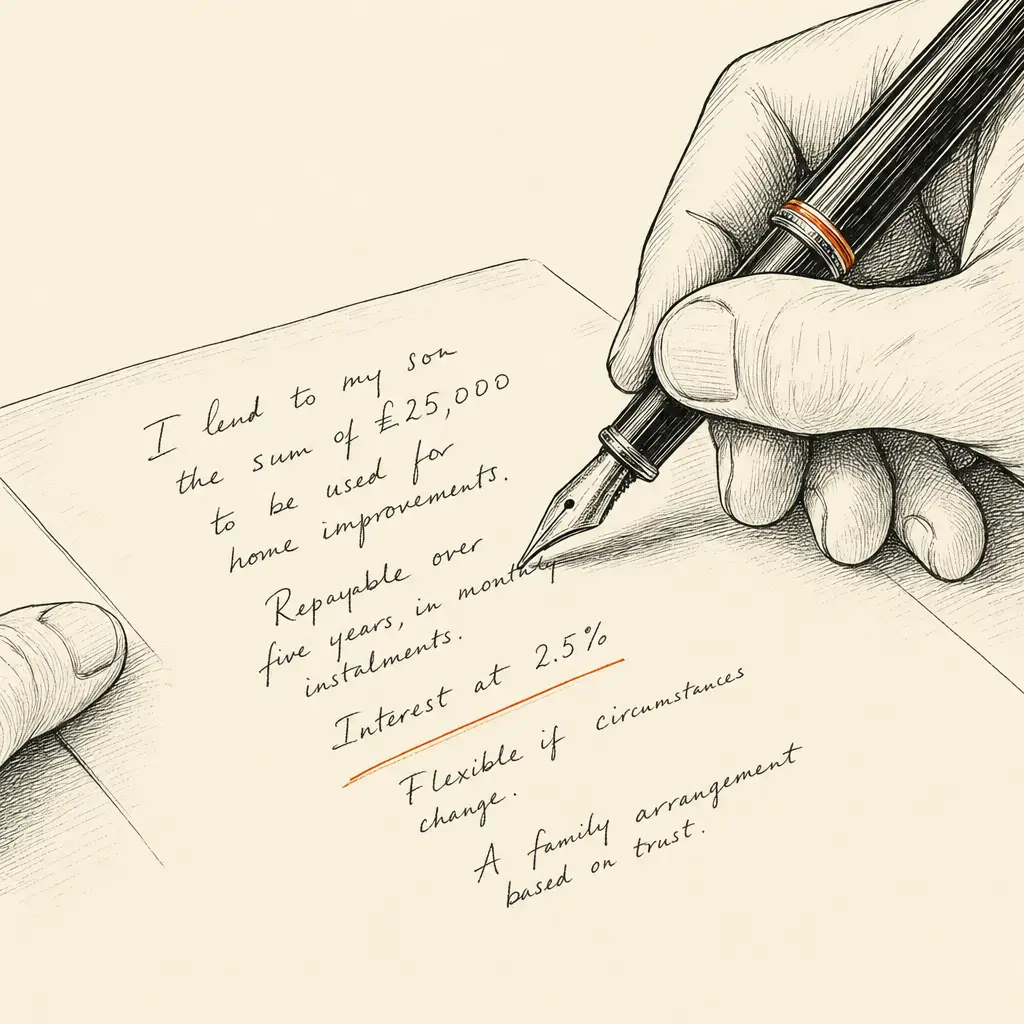
A written record of a loan between family members or friends — how much, on what terms, whether interest is charged, and how it is repaid — so the position is clear to everyone, including the estate.
Last updated
What it costs
- Private & Family Loan Agreements
- From £395
Quoted in writing before you commit to anything. The first phone call is free, and there's no travel charge for coming out to you anywhere in Kent and East Sussex.
Right for you if: you are lending money to someone close to you and you want it to be a loan rather than a gift, in a form that will still be clear in ten years.
Most family lending happens in a kitchen. Parents help with a deposit, a sibling covers a gap, someone lends against a business that’s about to turn a corner. The amount is agreed, the money moves, and nothing is written down because writing it down would feel like an accusation.
Then, years later, somebody has to answer a question nobody asked at the time. Was that a loan or a gift? Was interest ever intended? Is it still owed? And by then the person who could have settled it in a sentence is frequently no longer around to be asked.
What the document does
It records the arrangement you actually made:
- How much was lent, and when.
- Whether interest is charged, and if so at what rate — including saying expressly that it isn’t, where that’s the deal.
- How and when it’s repaid — fixed instalments, on demand, on the sale of a property, or on some other event.
- What happens if things go wrong — missed payments, or the borrower’s circumstances changing.
- What happens if you die before it’s repaid, which is the part most people haven’t thought about at all.
It’s short, it’s in plain English, and the point of it is that it’s readable by the people who’ll be reading it — which may well be your children, ten years from now, without you in the room.
Where it earns its keep
House deposits. By far the most common. Parents help one child onto the ladder and intend it as a loan, or as an advance on that child’s eventual inheritance. Undocumented, it becomes a gift by default — and if that child’s relationship later ends, money you intended to keep in the family can end up divided in a divorce settlement.
Fairness between children. If you’ve helped one child substantially and not the others, the question of how that’s accounted for when you die will come up. Recording it now, and dealing with it in your will at the same time, is the difference between a settled expectation and an argument at the worst possible moment.
Loans to a business. Where you’ve put money into a relative’s venture and everyone is currently optimistic. That’s precisely when to write it down.
Protecting the borrower too. A written agreement cuts both ways. It means the borrower knows exactly what’s owed and can’t have the terms revised on them, and it means they can show a mortgage lender the true position rather than guessing at it.
The bit that connects to your will
An unpaid loan doesn’t disappear when you die. It’s an asset of your estate, and your executors have a duty to collect it — which, if there’s no paperwork, means one of your children writing to another about money.
If what you actually want is for the debt to be written off on your death, or set against that person’s share of the estate, that has to be said in your will as well as in the agreement. The two documents need to be drafted with each other in mind, and the cheapest time to do that is at the same time.
What I don’t do here
I draft the agreement that records what you’ve decided. I don’t advise on whether to make the loan, on your tax position, or on anything that counts as regulated financial advice — and where a question of that kind comes up, I’ll point you at an accountant rather than have a guess. Loans secured on property are outside what I currently offer, for the reasons in the questions below.
Common questions
Isn't asking family to sign something a bit distrustful?
It's the opposite, and this is worth saying to whoever is uncomfortable about it. The document isn't there because you expect to be let down. It's there because in ten years' time the two of you may remember the conversation differently, or one of you may not be around to remember it at all, and the people left holding the question will be your other children and your executors. Writing it down protects the relationship far more reliably than leaving it unsaid.
What happens to the loan if I die before it's repaid?
An outstanding loan is an asset of your estate, and your executors are obliged to collect it — which puts them in the extremely unwelcome position of chasing a sibling for money if there is no paperwork and no agreement about what was intended. If your actual wish is that the debt should be written off on your death, or set against that person's share of the estate, that needs saying in your will as well as in the loan agreement. The two documents should be written together.
Is it a loan or a gift?
That is exactly the question that gets fought over, and it's why the document exists. Money handed to an adult child for a house deposit with nothing written down is very easy to characterise as a gift later — by that child, by their partner in a divorce, by HMRC, or by the other beneficiaries of your estate. A signed agreement made at the time is the clearest evidence there is of what was actually intended.
Do I have to charge interest?
No. Plenty of family loans are interest-free and the agreement can say so expressly, which is itself useful — it removes any suggestion that interest was assumed. If you do charge interest, bear in mind that it's income and may be taxable in your hands. I draft the agreement to record what you've decided; questions about your tax position are for an accountant, and I'll say so rather than guess.
What if the loan is secured on a property?
Then it becomes a different and more involved piece of work, because security over land has to be registered to be worth much. That's outside what I'm currently offering, and I'll tell you at the first call rather than halfway through. Most family loans are unsecured, and for those the agreement itself is the protection.
Not sure whether this is what you need?
That's what the first phone call is for. It's free, there's no obligation, and if something else would serve you better I'll tell you so.